

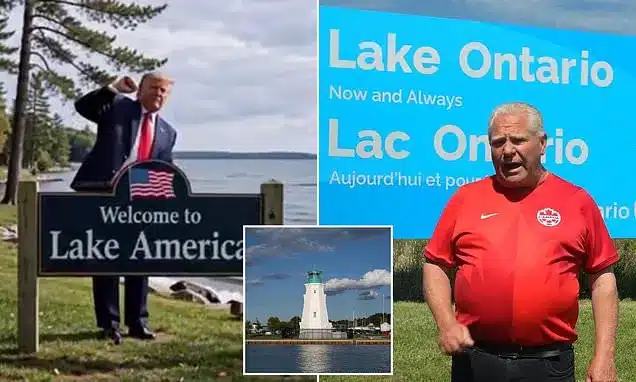
A contentious dispute over the naming of Lake Ontario has escalated, with U.S. President Donald Trump issuing an executive order to rename the body of water “Lake America” for federal purposes, prompting a strong rebuke and defiant counter-signage from Canadian officials. The move, seen by many as a symbolic gesture amidst ongoing trade disagreements, has drawn a sharp response from both the Premier of Ontario and the Prime Minister of Canada.
Trump’s Executive Order and ‘Lake America’ Campaign
On Thursday, President Trump signed an executive order directing the U.S. Department of the Interior to officially adopt “Lake America” as the name for the lake bordering the United States and Canada. This action comes as the two nations are embroiled in significant trade disputes, with Trump having previously threatened substantial tariffs on Canadian goods. While the U.S. president cannot unilaterally impose the new name internationally, the executive order signals his intent to assert a new designation for federal use.
Adding a theatrical element to his campaign, Trump later posted an AI-generated video on social media platform Truth Social. The video depicted him symbolically dismantling an existing sign and erecting a new one that read “Welcome to Lake America,” followed by him dancing. This digital display was released shortly after tangible actions were taken by Canadian officials.
Ontario Premier’s Defiant Response
In a direct challenge to the U.S. president’s initiative, Ontario Premier Doug Ford unveiled his own sign at a shorefront park in Hamilton, Ontario. The sign clearly stated: “Lake Ontario, Now and Always.” Standing before the marker at 50 Point Conservation Area, Ford declared his intention to send a clear message to President Trump.
“We are resilient, we are strong, and we will never, ever back down from a bully,” Ford stated, as reported by The Globe and Mail. He emphasized that the lake’s name would remain unchanged in Canada and globally, regardless of U.S. federal designations. “The lake will always be known as Lake Ontario in Canada and the rest of the world, no matter what Trump calls it,” he asserted.
Ford further elaborated on his stance in a video shared on X (formerly Twitter). “I’m here on the shores of beautiful Lake Ontario, a crown jewel of our province and our country,” he said. “You may have heard that President Trump is trying to rename this lake, all because he doesn’t like Ontario and Canada standing up for ourselves. But, let’s be serious: Long before President Trump, this lake was called Lake Ontario and long after President Trump is gone, it will still be called Lake Ontario.” The sign, he explained, was erected “just in case President Trump or anyone else forgets.”
Canadian Prime Minister’s Historical Context
The sentiments expressed by Premier Ford were echoed by Canadian Prime Minister Mark Carney. On the same day Trump signed his executive order, Carney affirmed that Canadians would continue to refer to the lake by its established name. “The name Lake Ontario comes from the Wendat word Ontari’io, which, appropriately, means ‘the lake is beautiful, the lake is big,'” Carney explained on X.
Carney highlighted the historical depth of the name, noting that it predates both the formation of Canada and the independence of the United States. “The name is more than 400 years old, predating both the Confederation of Canada and the Declaration of Independence of the United States of America,” he wrote. He also offered a subtle critique of the shifting political landscape in the U.S. under the Trump administration, referring to “the dramatic changes taking place south of his border.” Carney concluded by stating, “Canadians also know that naming reality means calling it Lake Ontario – then, now and always.”
Historical Significance and Joint Management
Lake Ontario, one of the five Great Lakes, forms a significant portion of the international border between New York State in the U.S. and the Canadian province of Ontario. Its shared status has been governed for over a century by the Boundary Waters Treaty of 1909, which established a framework for joint management of the waters between the two countries.
President Trump, however, indicated that the name change had been under consideration for an extended period. During the signing of the executive order, he humorously suggested that other major bodies of water might also be subject to renaming, referencing a past instance where he claimed the Gulf of Mexico was renamed “Gulf of America.” He mused about the possibility of renaming the Atlantic or Pacific Oceans.
Broader Trade and Political Tensions
The renaming dispute unfolds against a backdrop of heightened tensions in U.S.-Canada relations. Trade negotiations have faltered, with President Trump threatening to impose escalating tariffs on Canadian imports, including cars, trucks, automotive parts, and steel, aiming to incentivize manufacturing within the United States. Trump has stated his intention to raise tariffs on Canadian cars to 50 percent by 2027.
“The whole Canadian thing has to come to a stop,” Trump declared around the time of the executive order signing. “We are going to be doing tariffs on their cars that are coming in at a substantial level because we want to make the cars here. They can make their own cars if they want and they can continue to make cars for Canada but we don’t want them to make cars for the United States of America. It’s very simple. Likewise many other products.”
Beyond trade, Trump has also voiced grievances regarding Canada’s contributions to continental defense, stating, “We defend Canada for nothing, we don’t get anything.” He has characterized Canadian officials as difficult trading partners, describing them as “nasty people” who “feel entitled.”
Conclusion: A Symbolic Stand-off
The renaming of Lake Ontario represents a symbolic battleground in the broader economic and political friction between the United States and Canada. While President Trump’s executive order asserts a new name for U.S. federal purposes, Canadian officials, led by Premier Ford and Prime Minister Carney, have firmly rejected the change, grounding their position in historical precedent and national identity. The enduring name “Lake Ontario,” rooted in Indigenous history and recognized globally, stands in stark contrast to the politically charged “Lake America,” highlighting the deep divisions currently characterizing the relationship between the two North American neighbors.
