

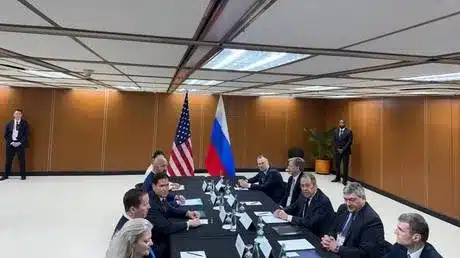
Russian Foreign Minister Sergey Lavrov and U.S. Secretary of State Marco Rubio convened for discussions in Manila, the Philippines, on the sidelines of the Association of Southeast Asian Nations (ASEAN) summit. The meeting marks a significant diplomatic engagement between two major global powers amidst a complex geopolitical landscape.
Context of the ASEAN Summit
The ASEAN summit serves as a crucial platform for regional dialogue and cooperation, bringing together leaders and top diplomats from Southeast Asian nations and their key international partners. Discussions typically cover a wide array of issues, including economic development, regional security, climate change, and maritime cooperation. The presence of high-level representatives like Lavrov and Rubio underscores the summit’s importance in addressing global challenges that extend beyond the immediate region.
Significance of the Bilateral Meeting
The meeting between the top diplomats of Russia and the United States is particularly noteworthy given the current state of international relations. While specific agendas for bilateral talks are often not disclosed in advance, such high-level encounters provide an opportunity to discuss pressing global and bilateral issues. These can range from ongoing international conflicts and arms control to economic cooperation and human rights. The ability for these two officials to meet, even briefly, can be seen as a signal of ongoing, albeit potentially strained, diplomatic channels.
Potential Discussion Points
While official readouts are pending, analysts suggest several key areas could have been on the table:
- Geopolitical Tensions: The broader international security environment, including ongoing conflicts and diplomatic standoffs, likely formed a significant part of the conversation.
- Regional Stability: Discussions may have touched upon the security dynamics within the Indo-Pacific region, a focal point for both Russia and the United States.
- Bilateral Relations: The state of U.S.-Russia relations, which have been fraught with challenges, might have been addressed, exploring avenues for de-escalation or specific points of contention.
- Economic Issues: Global economic trends, trade relations, and the impact of sanctions could also have been part of the dialogue.
Diplomatic Engagements at ASEAN Summits
ASEAN summits are frequently utilized by participating nations for bilateral meetings that may not occur in other settings. These informal or semi-formal gatherings allow for candid exchanges away from the intense scrutiny of domestic politics. For countries like Russia and the United States, whose diplomatic interactions can be highly sensitive, the neutral ground of an international summit offers a valuable opportunity to maintain communication.
The outcomes of such meetings are often assessed not just by the immediate agreements or disagreements reached, but by the very fact that dialogue occurred. In periods of heightened global tension, the continuation of diplomatic engagement, even at the highest levels, is often viewed as a positive indicator for managing potential crises and seeking common ground where possible.
Looking Ahead
The meeting between Foreign Minister Lavrov and Secretary Rubio in Manila represents a moment of diplomatic interaction within the broader framework of the ASEAN summit. As further details emerge from official statements, a clearer picture of the discussions and their potential implications for international relations will become available. The ability of world powers to engage in dialogue, even amidst significant disagreements, remains a critical component of global diplomacy.
