

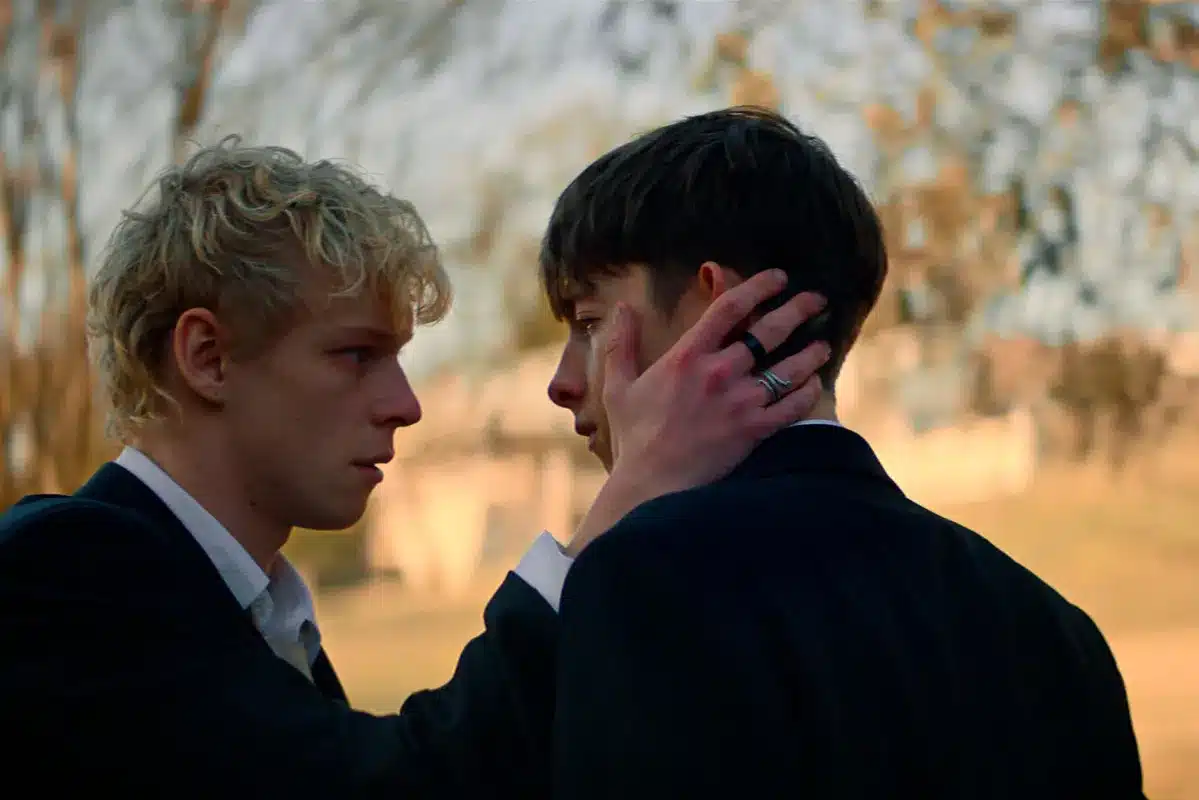
The Enigmatic Force Behind Australia’s Latest Queer Horror Darling
Adrian Chiarella’s directorial debut, Leviticus, is quickly establishing itself as a significant voice in Australian queer horror cinema. Praised for its compelling storyline, powerful performances, and evocative soundtrack, the film has resonated deeply with audiences. However, a central element of the narrative that has sparked considerable discussion is the true nature and appearance of the film’s titular Entity.
Please be advised: This article contains spoilers for Leviticus.
The Premise of Leviticus
Starring Joe Bird (known for his work in Talk To Me), Mia Wasikowska, and Stacy Clausen, Leviticus centers on the burgeoning connection between two teenage boys. Their relationship faces opposition from their community, leading to a ritual that unleashes a malevolent, deceptive entity. This entity manifests as the victim’s loved one, specifically appearing as each other to the film’s protagonists, Niam and Ryan.
Echoes of Horror, Unique Presentation
The thematic framework of Leviticus and its spectral antagonist draw parallels to other notable horror films, such as It Follows and Smile. However, a key distinction in Chiarella’s film is the deliberate ambiguity surrounding the Entity’s ultimate form. Unlike its cinematic predecessors, Leviticus never explicitly reveals the Entity in its true, unmasked state.
Director and Star Speculate on the Entity’s Form
When questioned about the specific appearance of the Entity, director Adrian Chiarella stated that he intentionally left its form open to interpretation. “It’s all in the eye of the beholder,” Chiarella explained.
Joe Bird offered his own speculation, suggesting the Entity might resemble a dark, abstract figure, perhaps akin to the unsettling imagery found in certain digital art or horror aesthetics. “Is it like a stick, black like Backrooms, like a stick figure before it turns into a ghost?” Bird mused, with Chiarella adding to the air of mystery with a simple, “Who knows?”
Inspiration Rooted in Social Commentary
Chiarella revealed that the inspiration for Leviticus stemmed from his observations of societal attitudes towards homophobia and perceived regressions in LGBTQIA+ acceptance. He described a personal journey from experiencing significant progress in gay rights during his youth to witnessing a recent shift. “I grew up in a time as a young gay man where we saw a lot of progress being made, and that all built towards a time when I was able to marry my husband,” Chiarella recounted. “But then, I think things sort of shifted in the last five to 10 years. We started to regress a little bit on that, and suddenly there was a little bit more homophobic language being used in public and in political speech, and little bits of microaggressions in day-to-day life. I wanted to do something that kind of explored that, but not in a way we’d seen before 30 years ago.”
Societal Realities Reflected in Fiction
The film’s narrative and its terrifying entity serve as a fictionalized exploration of real-world issues. Recent reports indicate a concerning rise in anti-LGBTQIA+ incidents. For instance, NSW Police have recorded over 200 such incidents since 2023, with a notable number involving young offenders using dating apps to target victims. Furthermore, survey data from 2024 to 2025 suggests an increase in the percentage of Australians who believe homosexuality is immoral, a shift from previous years.
While Leviticus is a work of fiction, its underlying themes powerfully reflect contemporary societal attitudes and the anxieties faced by the LGBTQIA+ community.
Leviticus is now in cinemas.
