

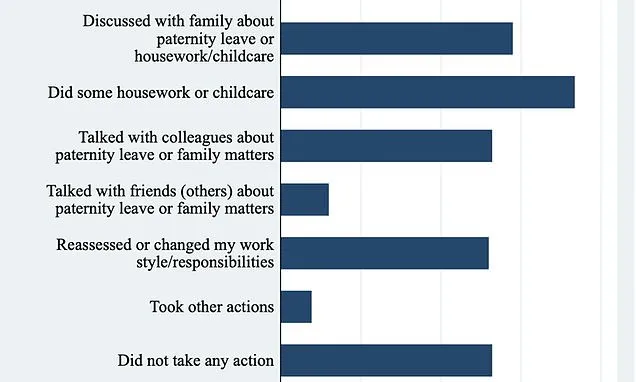
A recent study suggests that men’s involvement in childcare and household chores can be significantly increased through targeted training sessions. Researchers found that a single two-hour intervention effectively encouraged fathers to dedicate more time to family responsibilities, leading to a more equitable division of labor at home.
Training Boosts Fatherly Involvement
The research, conducted by a team from the University of Tokyo and published by the Center for Research and Education in Program Evaluation, involved over 1,200 male employees from four Japanese companies. Participants were divided into two groups. One group received a two-hour work-life balance training session led by experienced fathers, while the other group participated in an information campaign aimed at correcting misconceptions about colleagues’ views on paternity leave.
Analysis of the data collected through pre-intervention surveys and follow-up assessments over several months revealed that the training intervention was substantially more effective than the information-only campaign. Fathers who underwent the training demonstrated a marked increase in their weekend childcare time, dedicating approximately one extra hour per day to caring for their children. This effect was particularly pronounced among fathers with younger children, specifically those aged five and under.
Impact on Family Dynamics and Women’s Time
Professor Shintaro Yamaguchi, a lead researcher on the study, noted that the training not only increased fathers’ time spent with children but also triggered a broader renegotiation of household duties. “Training increased fathers’ weekend childcare time… especially among those with young children,” Professor Yamaguchi stated. “Much of the fathers’ new involvement happened when parents were with the children together, so what actually freed up mothers’ time was a reduction of roughly 2.6 hours in their housework.”
The study indicated that this shift in responsibilities allowed the partners of the trained fathers to reclaim significant time. Wives of men who participated in the training were able to increase their paid working hours by an average of 3.6 hours per week. Concurrently, they reported spending about 2.6 fewer hours on domestic chores, indicating a substantial redistribution of the overall workload within the household.
Addressing Misconceptions and Habits
The training program incorporated key messages designed to address common misconceptions men might hold about their contributions. It highlighted that fathers often overestimate the amount of time and effort they contribute to childcare and housework. By providing practical guidance and fostering a supportive environment, the intervention aimed to equip men with the skills and motivation to take on a more active role.
Researchers suggest that the findings challenge the notion that men are inherently less inclined to participate in domestic tasks. Instead, the study implies that a lack of participation may stem from ingrained habits or a lack of clear guidance, which can be addressed through structured interventions akin to workplace training.
Methodology and Findings
- Participant Recruitment: Over 1,200 male employees from four Japanese organizations were recruited.
- Intervention Groups: One group received a two-hour work-life balance training; the other received an information campaign.
- Data Collection: Surveys were administered before and after the interventions, tracking attitudes, childcare, housework, and working hours.
- Key Outcome: Trained fathers increased weekend childcare by ~1 hour/day.
- Impact on Partners: Wives increased paid work by ~3.6 hours/week and reduced housework by ~2.6 hours/week.
- Demographic Focus: The most significant gains in childcare were observed among fathers with children aged five or younger.
Broader Implications for Gender Equality
The study’s findings have significant implications for promoting gender equality both within the home and in the workplace. By demonstrating that men’s participation in domestic labor can be actively cultivated, the research offers a practical model for encouraging more balanced partnerships. This redistribution of labor not only benefits women by freeing up their time for professional pursuits or personal interests but also fosters stronger family bonds through increased paternal involvement.
Previous research has consistently shown that women disproportionately shoulder the burden of household chores and childcare. This imbalance has been linked to various negative outcomes for women, including increased stress, reduced leisure time, and even lower sex drives, as reported in other studies. The current research offers a potential pathway to mitigate these issues by actively engaging men in a more equitable division of domestic responsibilities.
Conclusion: Training as a Catalyst for Change
In conclusion, the study provides compelling evidence that men can be effectively trained to increase their engagement in childcare and household tasks. The success of the two-hour intervention highlights the potential for structured programs to shift ingrained habits and promote a more balanced division of labor within families. This approach moves beyond simply expecting change and actively facilitates it, offering a promising strategy for fostering greater equality and well-being in modern households.
