

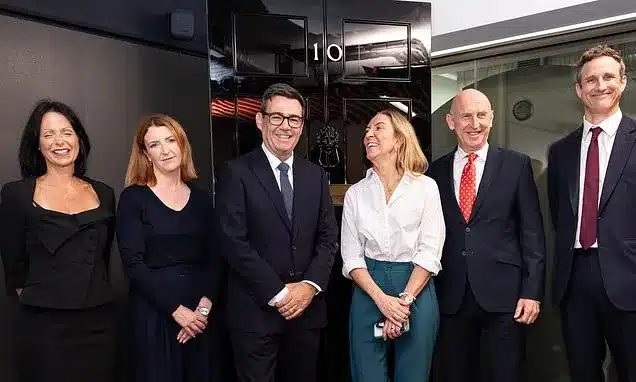
A new temporary office, dubbed ‘No10 North’, has officially opened in Manchester, aiming to symbolize a shift in governmental focus and power away from Westminster. The initiative, championed by Andy Burnham, Mayor of Greater Manchester, was inaugurated with a visit from the Prime Minister. However, the launch has been met with scrutiny regarding the associated costs, particularly concerning security and transport, with questions raised about the financial implications for taxpayers.
‘No10 North’ Initiative Launched in Manchester
Andy Burnham expressed profound satisfaction at the opening of the temporary ‘No10 North’ office, describing it as a momentous occasion. The Prime Minister attended the launch event, having traveled from Scotland via a government jet for a short flight. He addressed concerns about the financial burden on the public, arguing that establishing a northern base could ultimately prove more cost-effective than requiring officials to travel to London for every meeting.
The new office is situated in Heron House, a government building in central Manchester that also houses other agencies, including GCHQ. The location saw activity from various groups, including a bridal party observed entering the premises on the same day as the official opening.
Burnham, who has previously served as the mayor of Manchester and has family in the city, intends for ‘No10 North’ to be a tangible representation of his commitment to devolving power and decentralizing government functions. This move is part of a broader agenda to empower regions outside the capital.
Security and Operational Costs Under Scrutiny
Significant security enhancements have been implemented at Heron House, with armed police visible during the Prime Minister’s visit. Efforts have also been made to improve the surrounding area, including Albert Square. While Downing Street has stated that the operation of ‘No10 North’ will be absorbed by existing Cabinet Office budgets and will not incur additional taxpayer expense, independent assessments suggest otherwise.
Experts have voiced concerns that the extensive security measures required for a prime ministerial office, including round-the-clock protection, could lead to substantial, albeit unquantified, costs. This contrasts with the typical security arrangements for government buildings in London, many of which are already subject to public access restrictions.
Burnham’s Vision and Personal Connection
During an address to staff at the Manchester office, Burnham conveyed his deep personal connection to the initiative. He reflected on his early life in Manchester, recalling the economic challenges the city faced decades ago and the necessity for young people to leave in search of opportunities. He sees ‘No10 North’ as a crucial step towards empowering local communities and enabling them to drive their own development, mirroring Manchester’s own transformation.
“Putting power in every postcode so that people can turn things around for themselves and make changes just as this great city has done and the other English cities are doing through devolution,” Burnham stated, emphasizing the principle of distributed governance.
A replica of the iconic Downing Street door, created by artist Jason Bruges as part of the GREAT Britain Campaign, was displayed for the National Economic Council meeting held at the new office.
Long-Term Plans for a Permanent Base
The temporary setup at Heron House is a precursor to a more permanent ‘No10 North’ facility. The Treasury had previously approved the initial plans for a civil service ‘digital campus’ in Manchester, a project that has been in development since 2017 when a disused retail park was acquired. This site is now earmarked as the future location for the permanent northern base.
Construction on the five-acre site is anticipated to commence in the coming years. However, the projected operational date for this permanent facility is 2032. This timeline places its completion significantly after the next general election, which is expected by 2028 at the latest.
The Prime Minister’s spokesperson reiterated the government’s position that the ongoing costs associated with ‘No10 North’ will be managed within the existing budget of the Cabinet Office, asserting that no supplementary funding from taxpayers is allocated for this venture.
Conclusion: Balancing Ambition with Accountability
The establishment of ‘No10 North’ represents a significant symbolic gesture towards regional decentralization and a potential recalibration of governmental presence. While Mayor Burnham views it as a pivotal moment for Manchester and a model for devolution, the practicalities and financial commitments remain a focal point of public and expert discussion. The government’s assurance of no additional costs is countered by expert warnings about the inherent expenses of enhanced security and infrastructure for a high-profile office. The long-term vision for a permanent base, set to be operational in 2032, underscores the project’s ambitious scope, even as the immediate financial implications continue to be debated.
