

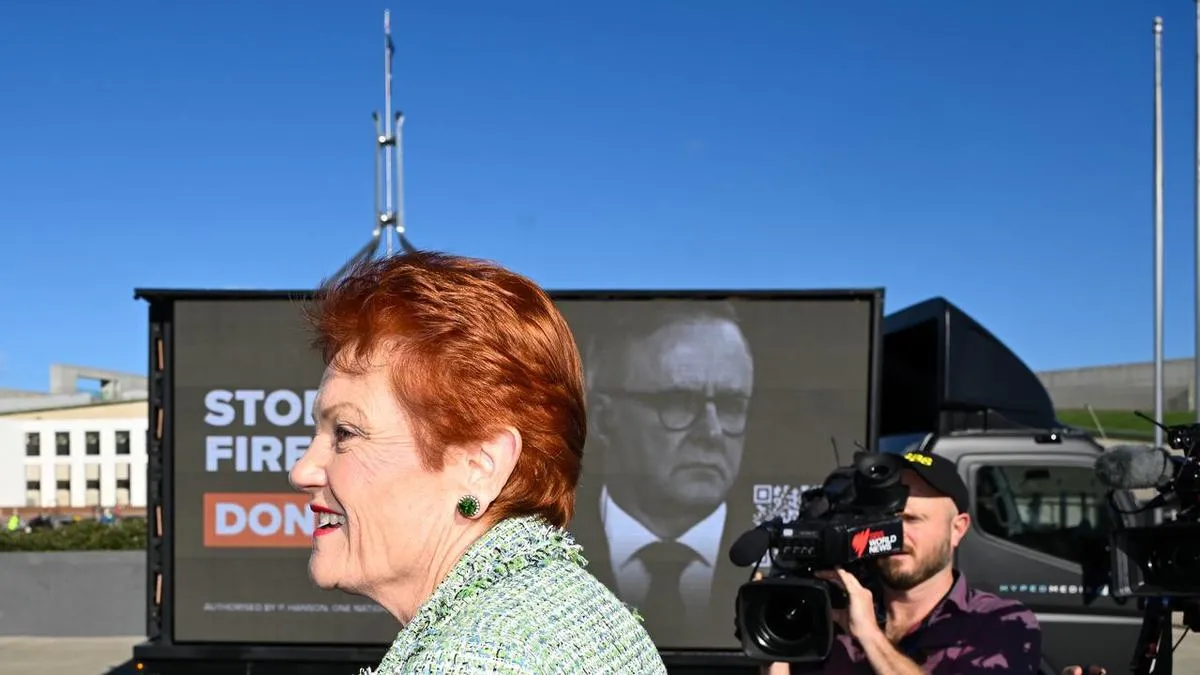
One Nation is experiencing a surge in public support, with the latest Newspoll indicating a rise in its primary vote, even as its leader, Pauline Hanson, faces significant criticism for her recent European tour. The controversial trip, which included a meeting with a far-right activist and remarks about Australia’s immigration policies and social issues, has drawn sharp rebukes from political opponents, including Prime Minister Anthony Albanese.
One Nation’s Electoral Performance
The most recent Newspoll, as reported by The Australian, reveals a notable shift in voter sentiment. One Nation’s primary vote has climbed by one percentage point to 30 percent, placing it on par with the Australian Labor Party. Concurrently, the Coalition has also seen an uptick in support, moving from historic lows of 17 percent to 19 percent. This poll follows a period where One Nation’s support had previously dipped two points from a high of 31 percent in June, after Senator Hanson’s address at the National Press Club.
Senator Hanson’s European Visit and Public Statements
Senator Hanson’s recent visit to Europe has been a focal point of political debate. In the United Kingdom, she addressed a conservative conference in London, articulating views that Australia has been “flooded” with migrants and has become excessively “woke” regarding transgender rights. Her itinerary also included a visit to Italy, where she was photographed with prominent mining magnate Gina Rinehart at a luxury resort in Sicily.
Furthermore, Senator Hanson met with Tommy Robinson, a controversial far-right activist, during her European travels. These engagements and public statements have led to accusations from political rivals that she is “talking Australia down” on the international stage.
Prime Minister’s Response
Prime Minister Anthony Albanese publicly criticized Senator Hanson’s actions, stating his astonishment that an Australian senator would travel overseas specifically to “denigrate and talk down Australia.” He contrasted her approach with his own practice of promoting the nation abroad, emphasizing that he finds her engagement with “fringe people” and her negative commentary inappropriate.
One Nation’s Stance on Immigration and Policy
During an appearance on Channel Seven’s “Spotlight on Sunday,” Senator Hanson reiterated her views on multiculturalism and her perception of challenging the “establishment.” She also controversially suggested that negative migration issues in Australia began following the abolition of the White Australia policy.
However, One Nation MP Barnaby Joyce, while defending his leader’s right to express her views, clarified that the party does not advocate for the reintroduction of the White Australia policy. He acknowledged that while the policy’s dismantling was a positive step, challenges arose when some individuals did not integrate into Australian society, leading to a dilution of traditional Australian culture.
Broader Controversies and Criticisms
Senator Hanson’s remarks at the CPAC conference in London, where she stated, “don’t apologise for being white, I am sick of hearing about white privilege,” have also contributed to the controversy surrounding her trip. This statement, along with her broader comments on immigration and social issues, has been met with criticism.
The scrutiny extends beyond Senator Hanson’s recent activities. Comments made by fellow One Nation Senator Malcolm Roberts in the past, including his promotion of material by conspiracy theorists and individuals accused of anti-Semitism, have also drawn criticism and raised concerns about the party’s associations and public discourse.
Shifting Poll Landscape
The Newspoll results indicate a dynamic political landscape. Labor’s primary vote has seen a decline of three points, falling from 33 percent. The Coalition’s increase in support comes after a series of decreases in its primary vote, suggesting a potential stabilization or shift in voter priorities. The current poll results place One Nation in a competitive position, drawing attention to the party’s growing influence amidst ongoing political debate and controversy.
Conclusion
As One Nation gains traction in the polls, the party and its leader, Pauline Hanson, are navigating a period of intense public and political scrutiny. Senator Hanson’s recent European tour and her associated public statements have ignited debate on immigration, national identity, and Australia’s international image. While the party sees a rise in electoral support, the criticisms leveled against its leadership highlight the ongoing tensions and differing perspectives within the Australian political sphere.
