

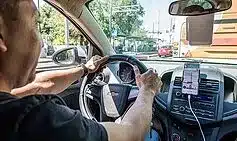
Navigating the rules around using a mobile phone while driving can be a complex area, especially with the prevalence of hands-free technology and integrated vehicle displays. A key question for many drivers is whether it is permissible to touch a phone that is securely mounted in a holder. Barrister Daniel J. ShenSmith has clarified the legal position, explaining that while the law appears straightforward, there are important nuances to consider.
Understanding the Legislation on Mobile Phone Use While Driving
The primary legislation governing the use of mobile phones by drivers in the UK is the Road Vehicles (Construction and Use) Regulations 1986, specifically an amendment that introduced regulation 110. This regulation falls under section F, which deals with the “Avoidance of danger.” A critical aspect highlighted by ShenSmith is section F7, which defines what constitutes “using” a phone. This definition is broad, encompassing actions from simply lighting up the screen to unlocking the device and making calls.
ShenSmith explained the core principle: “The short version is technically, yes, it is legal to touch your phone so long as it is securely mounted in a cradle.” He drew an analogy to interactive screens found in vehicles like Teslas, stating that answering a call by pressing a button on such a screen, without holding the device, would not typically constitute a breach of the law. The crucial factor is that the device is not handheld and the action taken is not inherently distracting.
The Definition of “Using” a Phone
The legislation clarifies that a mobile telephone or other device is considered “hand-held” if it is, or must be, held at some point during its use. ShenSmith emphasized that this definition does not extend to devices placed in holders. Therefore, if an action can be performed by pressing a button on a mounted device, without needing to pick it up, it generally does not fall under the prohibition of using a hand-held phone.
He elaborated, “So, if it must be in your hand to do whatever it is you’re doing, then it’s caught by the regulations. It does not say that, you know, if it’s in a cradle and you press a button.” The key distinction lies in whether the device needs to be physically held to operate. If a function, such as answering a call, can be initiated by a simple press of a button on a mounted phone or an in-car screen, it is not considered “hand-held” in the context of the regulations.
Highway Code Rules and Due Care and Attention
Beyond the specific regulations on hand-held devices, Rule 149 of the Highway Code is also highly relevant. This rule mandates that motorists “MUST exercise proper control” of their vehicles at all times. It explicitly forbids the use of any hand-held mobile phone or similar interactive communication device for any purpose while driving or supervising a learner driver.
Rule 149 also prohibits picking up a phone to dial a number before placing it in a holder, and using the phone while stationary in traffic. ShenSmith noted that even if a driver technically complies with the regulation regarding hand-held devices, they could still face charges of driving without due care and attention, or even careless or dangerous driving, if their actions on the phone caused sufficient distraction leading to an accident.
He explained that using any in-vehicle screen technology, even if legally permissible under certain conditions, could be deemed a breach if it compromises the driver’s ability to maintain proper control of the vehicle. The overarching requirement to drive with due care and attention remains paramount.
Exceptions to the Rules
There are limited exceptions to the general prohibition on using mobile phones while driving. These include:
- Contactless Payments: Drivers can use their phone for contactless payments, but only when stationary and if the transaction is immediate.
- Genuine Emergencies: In a genuine emergency, drivers may use their phone to call emergency services.
These exceptions are narrowly defined and require the driver to be stationary for payments, and the situation to be a genuine emergency for communication.
Expert Advice on Mobile Phone Use While Driving
ShenSmith offered practical advice for motorists. He recommends restricting mobile phone use to navigation (sat nav) purposes only. If drivers choose to use their phone for calls, he advises limiting interaction to simply pressing a button to answer and another to end the call, provided the phone is securely mounted.
He cautioned against dialing numbers, even with the phone in a holder, as this action could easily be interpreted as failing to drive with due care and attention. The emphasis remains on minimizing distraction and maintaining full control of the vehicle at all times.
Official UK Government guidance supports the use of hands-free devices, provided the driver does not hold the phone at any point during its use. This includes systems operated via voice command or mounted devices like dashboard holders or windscreen mounts. The core principle is that the device must not be hand-held during operation.
Conclusion: Prioritizing Safety and Compliance
In summary, while touching a mobile phone secured in a holder to perform simple functions like answering or ending a call is technically permissible under UK law, drivers must remain vigilant. The overarching duty to maintain proper control of the vehicle and drive with due care and attention always applies. Any action that leads to distraction, regardless of whether the phone is held or mounted, can have serious legal consequences, especially if it contributes to an accident. Limiting phone interaction to essential, hands-free operations or navigation is the safest and most legally sound approach.
