

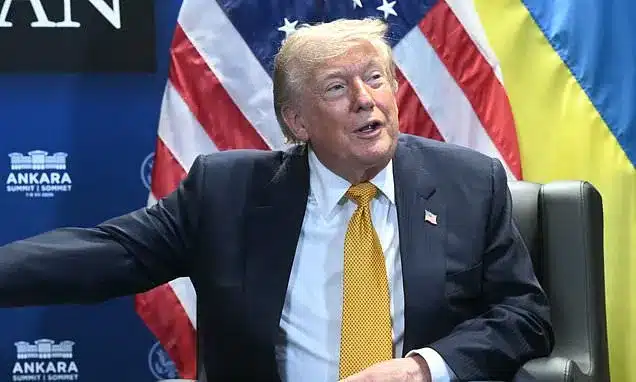
During a joint appearance with Ukrainian President Volodymyr Zelensky at a recent NATO summit, former President Donald Trump made two notable verbal missteps that drew attention. These instances occurred while Trump was fielding questions from reporters, leading to renewed discussions about his public speaking and cognitive fitness.
Verbal Slip-Ups at NATO Summit
One of the initial gaffes involved Trump discussing missile defense capabilities. While intending to refer to Iran, he mistakenly identified the country as Japan. “We had 111 missiles shot by the Islamic Republic of Japan,” Trump stated, before continuing to discuss the successful interception of these projectiles without apparent pause.
Shortly after, Trump appeared to confuse the identities of the leaders of Ukraine and Russia. While addressing President Zelensky and gesturing towards him, Trump posed a question to a reporter, asking, “Do you have a question for President Putin?” He repeated the question, indicating he intended to relay it to the Russian president. Trump then mentioned he had a call scheduled with Putin later that day and persisted until a question was directed towards the Russian leader.
Reactions and Speculation
These verbal errors quickly became a topic of online commentary. A pro-Ukraine social media account, noting Trump’s age, suggested he was experiencing cognitive decline. Michael MacKay, identified as holding a PhD from the London School of Economics, posted on X (formerly Twitter), “Trump’s dementia is profound.” This sentiment echoed remarks made by Illinois Governor JB Pritzker the previous week, who expressed to CNN his belief that Trump was suffering from a mental disease.
Conversely, representatives for Trump defended his performance at the summit. White House Press Secretary Karoline Leavitt characterized Trump’s participation as a “marathon, high-energy performance.” Leavitt stated that Trump “commanded every room” and engaged in multiple press availabilities, including a solo press conference, taking unscripted questions on various subjects. She concluded that he “left the summit with a stronger NATO and more united free world.”
Context of Health Concerns
Trump, who is the oldest person ever elected to the U.S. presidency, has faced scrutiny regarding his health and stamina. This has been amplified by his own frequent public commentary on the health of his predecessor, President Joe Biden.
Specific physical observations that have drawn attention include visible swelling in his legs, bruising on his hands, and instances where he appeared to briefly doze off during public events. The White House has provided explanations for these observations:
- Leg Swelling: Attributed to chronic venous insufficiency, described as a common circulatory issue in older individuals.
- Hand Bruising: Explained as a result of frequent handshakes and regular aspirin use. The White House noted that bruising has appeared on both hands and that Trump has sometimes used makeup or bandages to conceal it.
- Apparent Dozing: Those close to Trump have denied he struggles with sleep. Secretary of State Marco Rubio, for instance, stated in a congressional hearing that he had never seen Trump fall asleep and noted that Trump often contacts him in the early morning hours.
Trump’s age and the public’s interest in presidential fitness have placed a spotlight on such moments. His verbal slip-ups at the NATO summit, while brief, have reignited discussions about his public speaking and cognitive condition, drawing varied interpretations from critics and supporters alike.
