

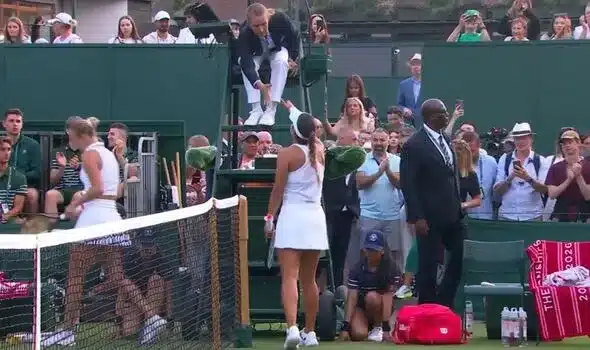
Wimbledon’s famously stringent all-white dress code has once again come under scrutiny, this time catching Spanish tennis player Jessica Bouzas after her first-round victory. While Bouzas secured a comfortable win against Anastasia Potapova on Court 17, an official noted a minor infraction regarding her attire, leading to a discussion with the umpire.
The Incident: A Glimpse of Black
The match concluded with Bouzas defeating Potapova with a score of 6-2, 6-3. However, as the players were leaving the court and spectators began to depart, something on Bouzas’s outfit drew the attention of an official. It was revealed to be a black undershirt, a small portion of which had become slightly visible on her lower back towards the end of the match. The umpire approached Bouzas to address the issue, issuing a reprimand and a reminder to ensure such a breach does not occur again during the tournament.
Bouzas, ranked world No. 52 and a fourth-round participant at Wimbledon the previous year, later explained the situation. Speaking to Movistar Plus Deportes, she acknowledged the strictness of the tournament’s regulations. “A problem here is that they are very strict with many things,” Bouzas stated. “I think it was a bit of black here, and you can’t do that, so I will have to sort it out. But yes, they are very strict with things like this, so now I’ll see how I can fix it.”
Wimbledon’s All-White Policy Explained
Wimbledon’s dress code is one of the most iconic and rigorously enforced in professional tennis. The tournament’s guidelines are exceptionally detailed, emphasizing a near-complete adherence to white attire. The rules stipulate:
- Near-White Dominance: Competitors must wear suitable tennis attire that is almost entirely white. This rule applies from the moment a player steps onto the court surroundings.
- Definition of White: The colour white is strictly defined and does not include off-white or cream shades.
- Colour Restrictions: Solid masses or panels of colour are prohibited.
- Acceptable Trim: A single trim of colour around the neckline and sleeve cuffs is permissible, provided it does not exceed one centimetre (10mm) in width.
- Pattern and Logo Interpretation: Colour contained within patterns is measured as if it were a solid mass of colour and must adhere to the one-centimetre limit. Logos created through variations in material or patterns are not considered acceptable.
The strictness of these regulations means that even minor deviations, such as a visible coloured undergarment, can lead to a warning. The policy aims to maintain the tournament’s traditional aesthetic and unique atmosphere.
Context and Future Implications
This incident highlights the perennial challenge players face when competing at Wimbledon, requiring meticulous attention to detail regarding their on-court apparel. While Bouzas’s infraction was minor and seemingly unintentional, it underscores the unforgiving nature of the dress code. Players often have to make specific choices about their undergarments and accessories to comply fully.
Bouzas’s victory placed her in the second round, where she was scheduled to face Ukrainian player Dayana Yastremska. The focus now shifts to whether Bouzas, or any other player, will encounter further dress code issues as the tournament progresses. The tradition of Wimbledon’s white attire remains a defining characteristic, ensuring that players must balance performance with strict sartorial compliance.
The tournament has a long history of enforcing its dress code, sometimes leading to memorable moments. In the past, players have been asked to change non-compliant items, ranging from coloured bras to shoes. The underlying principle is to preserve the visual identity of the championships, which is deeply intertwined with its history and tradition.
For Bouzas, the focus will be on her performance in the subsequent rounds, hopefully without further wardrobe-related distractions. Her ability to navigate the tournament successfully will depend not only on her tennis skills but also on her adherence to Wimbledon’s unique regulations. The incident serves as a reminder to all competitors of the importance of understanding and respecting the tournament’s specific rules, ensuring their focus remains on the game itself.
