

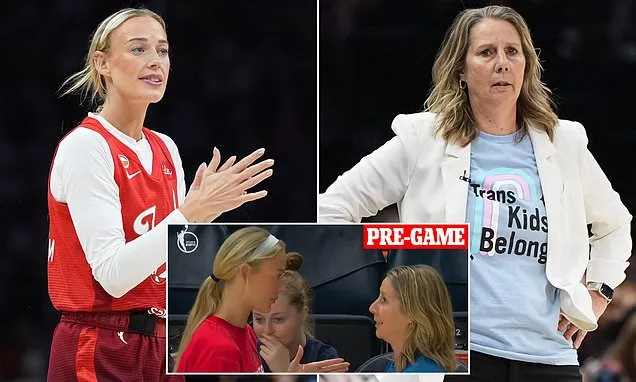
Minnesota Lynx head coach Cheryl Reeve has spoken about her on-court discussion with Indiana Fever player Sophie Cunningham, which occurred amidst protests and crowd boos directed at Cunningham in Minneapolis. The conversation took place before the Lynx secured a 108-100 victory over the Fever. Cunningham has recently become a focal point in discussions surrounding transgender athletes in women’s sports after expressing her views last month.
Coach Reeve’s Stance and Conversation with Cunningham
Cheryl Reeve, who also holds a coaching position with the U.S. Women’s National Basketball Team, addressed the meeting with Cunningham after the game. Reeve had previously shown her support for transgender inclusion by wearing a t-shirt that read ‘Trans kids belong’ during the Lynx’s win. Describing the pre-game talk with Cunningham, Reeve stated, ‘I think it’s great. I think both of us understand that we have platforms and we both talked about wanting to, more than anything, educate. There are some things that we have in common, and maybe some things you differ on, just like any issues. I think it’s how you handle things. It was nice to be in person, for sure.’
While Reeve did not disclose the full details of their private conversation, she elaborated on her personal perspective regarding transgender athletes in women’s sports. ‘I come from a space of inclusion,’ Reeve explained. ‘The narrative that I think is problematic is to suggest that transgender athletes are the biggest problem in women’s sports. This is what’s bothersome. There is a faction of people in our country that are making this a massive issue.’
Context of the Transgender Athlete Debate in Sports
The WNBA currently does not have any players who were assigned male at birth. Similarly, such players have not historically been part of the league. The issue of transgender athletes has gained national attention primarily through cases at the NCAA level. However, the number of transgender student athletes participating in collegiate sports remains extremely low. NCAA President Charlie Baker estimated in 2024 that fewer than 10 such athletes were competing at that time.
Cunningham’s Comments and Public Reaction
Sophie Cunningham’s recent comments to ESPN, stating that young girls ‘shouldn’t have to go against biological men’ when competing in sports, have ignited significant public debate. These remarks have led to demonstrations outside WNBA arenas during the Indiana Fever’s road games. Supporters of Cunningham have gathered in cities including Seattle, Portland, and Minneapolis.
The reception for Cunningham has varied. While some fans have shown support, others have voiced strong opposition. In Portland, Cunningham was audibly booed by the home crowd. Following the booing, Cunningham appeared to make a hand gesture, which some interpreted as calling the fans ‘losers.’ However, she later clarified on social media, stating, ‘I didn’t call them losers but I did talk s***.’ She further appeared to amplify the situation by posting a video of herself making a shushing gesture and another clip showing her giving her game-worn shoes to a young fan as a token of appreciation.
Protests and Clashes Outside Target Center
The tension surrounding Cunningham’s stance extended beyond the court, manifesting in chaotic scenes outside Minneapolis’s Target Center. Rallies organized by opposing groups led to direct clashes between Cunningham supporters and pro-trans demonstrators. Videos captured a physical altercation where a Cunningham supporter allegedly snatched a t-shirt from a pro-trans demonstrator. In response, a group of pro-trans protesters reportedly surrounded the woman, retrieved the shirt, and engaged in a shouting match.
Security personnel and arena staff intervened to de-escalate the situation and prevent further escalation. This incident marked the third consecutive road game for the Indiana Fever where demonstrations have occurred outside the venue, following similar events in Seattle and Portland. These protests highlight the polarized views on the inclusion of transgender athletes in women’s sports, a debate that has become increasingly prominent in public discourse.
Conclusion: Navigating Platforms and Public Discourse
The interaction between Coach Reeve and Sophie Cunningham, alongside the public demonstrations, underscores the complex and often contentious nature of discussions surrounding transgender athletes. Reeve’s emphasis on education and inclusion, contrasted with Cunningham’s expressed concerns, reflects a broader societal dialogue. Both figures, by virtue of their public platforms, are participants in shaping this conversation. The events in Minneapolis serve as a stark reminder of the passionate emotions involved and the challenges of navigating these sensitive issues in the public sphere.
