

[ad_1]

The Western canon of artwork historical past is dominated by white males. The canon itself is the product of centuries of scholarship additionally carried out by white males. However the Getty, and lots of different artwork establishments throughout the nation, are decided to alter that. They’re working to develop the canon to incorporate ladies and artists of shade who’ve contributed drastically to inventive heritage and cultural dialogue over the centuries however stay largely underrepresented.
The continuing interrogation of which artists and what work needs to be represented to totally seize the depth and breadth of the human expertise is now dealing with fierce pushback from the Trump administration. The sustained strain marketing campaign started in January with an govt order to roll again range, fairness and inclusion efforts within the federal authorities, which resulted within the Smithsonian Establishment shuttering its workplace of range. Then in March, Trump issued one other mandate focusing on “divisive, race-centered ideology” on the Smithsonian and nationwide parks.
On this fraught cultural second, the privately funded Getty — one of many world’s richest artwork establishments — stands aside. And the place different museums is likely to be feeling the coolness of Trump’s actions, the Getty is tirelessly shifting ahead with the implementation of an ever-increasing raft of initiatives, grants and academic and analysis packages aimed toward supporting and preserving Black arts and cultural heritage in Los Angeles and throughout the nation.

Stylesville Barbershop & Magnificence Salon in Pacoima is among the many buildings important to Black heritage in L.A. which have been designated Historic-Cultural Monuments.
(Cassia Davis / J. Paul Getty Belief)
Establishing landmarks
“It’s an iterative course of,” says Rita Cofield, an affiliate venture specialist on the Getty Conservation Institute who leads the African American Historic Locations venture, which has been figuring out native websites of cultural significance to the Black neighborhood and dealing to register them as historic landmarks. “The extra you be taught, the extra there’s. The extra historical past you already know, the extra historical past that’s revealed and the extra the neighborhood involves you.”
The venture is at present within the course of of choosing its second spherical of Black heritage websites and hopes to get them designated as landmarks within the subsequent 12 months or so. Its first spherical included Tom and Ethel Bradley’s Leimert Park residence, in addition to Stylesville Barbershop & Magnificence Salon in Pacoima; St. Elmo Village and Jewel’s Catch One in Mid-Metropolis; the California Eagle newspaper in South L.A.; and New Bethel Baptist Church in Venice.
Rising archives of defining historical past
One other key program is the Getty’s African American Artwork Historical past Initiative, which was launched in 2018 via the Getty Analysis Institute. It serves as a serious West Coast heart of scholarship via preservation and documentation of artist archives, unique analysis and the creation of oral histories. Amongst its proudest acquisitions are the archives of the Johnson Publishing Co., based in 1942 by African American businessman John H. Johnson and recognized for Ebony and Jet magazines. The archive consists of greater than 4.5 million photos primarily from Black photographers, together with Ebony’s Moneta Sleet Jr., who received a Pulitzer Prize for function pictures for a picture he captured of Coretta Scott King at husband Martin Luther King Jr.’s funeral.
“They’re not simply press photographers, they had been nice photographers. And a few of the work that we’re going to be doing is showcasing and bringing again into public view not solely the content material, however what actually glorious artists a few of these photographers had been,” says Andrew Perchuk, interim director of the Getty Analysis Institute.
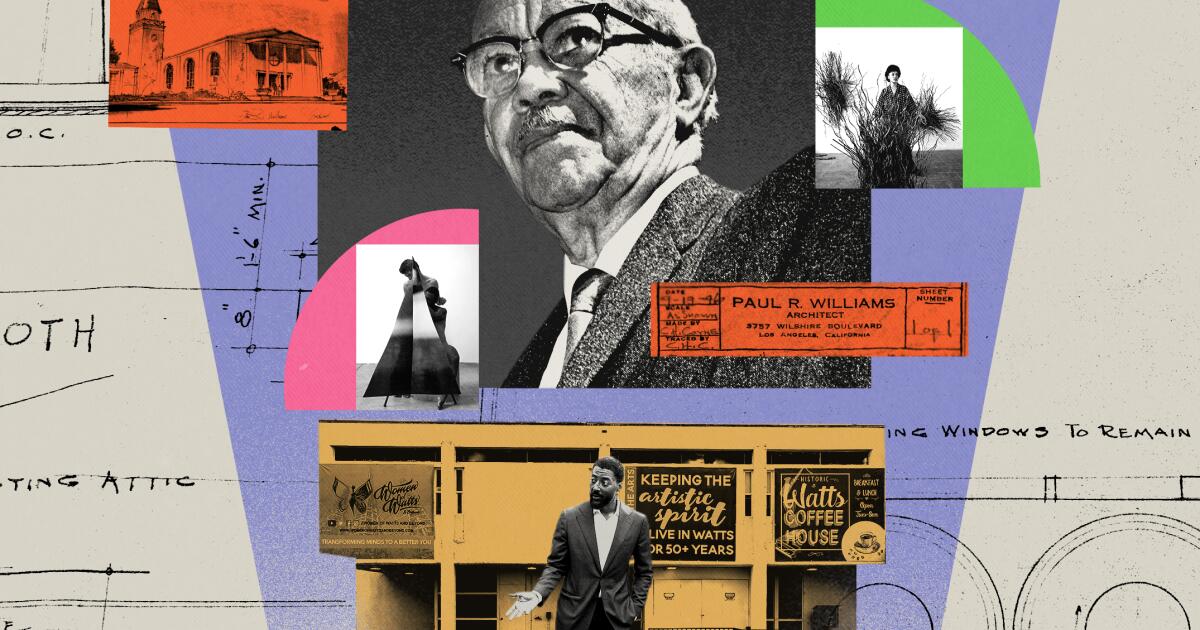
The archives of Paul R. Williams, who in 1921 grew to become the primary Black architect to be licensed west of the Mississippi, are additionally being preserved by the venture. A few of Williams’ papers had been saved in a financial institution, which was burned within the 1992 riots that consumed the town within the wake of the Rodney King verdict. Nonetheless, the majority of Williams’ papers turned out to be saved safely elsewhere. In 2020, the Getty and the USC College of Structure acquired 35,000 architectural plans and 10,000 unique drawings, together with blueprints, hand-colored renderings, classic images and correspondence.

LeRonn Brooks, affiliate curator for contemporary and up to date collections, examines pictures of the Beverly Hills Resort from architect Paul R. Williams’ archive.
(Juliana Yamada / Los Angeles Instances)
“It’s additionally not solely what we purchase, however that we’re thought companions with Black cultural heritage establishments,” says Kara Olidge, the Getty Analysis Institute’s affiliate director of collections and discovery. “It’s the work that we’re doing to protect supplies, but it surely’s additionally about partnerships and amplifying the significance of African American artwork inside the canon.”
Starting in February 2027, the Getty, USC and Los Angeles County Museum of Artwork will stage the first-ever main exhibition of Williams’ work throughout the three places.
“It’s additionally to let Black communities in L.A. know that they’ve a spot at the Getty, that, if nothing else, they’ll see themselves,” mentioned LeRonn Brooks, affiliate curator for contemporary and up to date collections, who focuses on African American artwork. “So there’s Paul Williams, a Black architect who was invisible in plain sight, and most of L.A. doesn’t know that he made so many buildings right here.”
Preserving structure
A type of buildings overlaps with one other Getty initiative known as Conserving Black Modernism, a $4.65-million grant partnership between the Getty Basis and the African American Cultural Heritage Motion Fund that works to establish, protect and strengthen fashionable structure by Black architects and designers. This system launched in 2022 and at present contains 21 buildings throughout the nation, together with Williams’ Founder’s Church of Spiritual Science, which was in-built 1960, and Watts Occurring Cultural Heart — designed by architects Robert Kennard and Arthur Silvers.

Paul Williams’ Founder’s Church of Spiritual Science is among the many beneficiaries of the Getty’s Conserving Black Modernism initiative.
(Mark Clennon)
When the Getty realized Black architects weren’t represented within the buildings that had been being recognized via its broader Preserving It Trendy initiative, it began working with the Nationwide Belief for Historic Preservation to acknowledge these buildings.
“To understand that also solely 2% of the registered architects on this nation are African American is fairly astounding,” says Getty Basis Director Joan Weinstein. “One of many biggest studying experiences via that is to see how the definition of modernism itself has expanded … and so it’s not simply concerning the formal traits, it’s concerning the social settings through which these buildings had been constructed, and oftentimes they had been church buildings, neighborhood areas and buildings on [historically Black colleges and universities’] campuses.”
Giving grants for analysis and community-building
HBCU libraries, in addition to different analysis facilities, universities and museums are benefiting from grants given by the Getty Basis as a part of its ongoing Black Visible Arts Archives program. In August, it awarded $1.5 million to seven establishments, together with the Amistad Analysis Heart in New Orleans, Cal State Los Angeles and Visible AIDS in New York.
The aim is to allow teams to arrange, protect and digitize huge archives which have up to now remained largely uncatalogued and unavailable to students — and to construct neighborhood between archive stewards, says Getty Basis senior program officer Miguel de Baca, who has been assembly with potential grantees and logging a whole lot of hours of journey in what he calls a “bespoke” technique of identification.
De Baca knew from private expertise that there was an pressing want for these disparate, typically hidden archives to be made extensively obtainable. In 2003 he took an African American artwork historical past class in graduate college, and when he tried to place collectively a bibliography, he discovered it tough to seek out main sources. In 2021 he assembled members of the HBCU Library Alliance “to listen to and assess the universe of wants amongst Black archivists particularly.” He later interviewed practically two dozen historians of African American artwork historical past and visible tradition research to pinpoint collective wants.

Carla J. Williams’ self-portrait “Untitled (projection) #P37” is on show on the Getty.
(The J. Paul Getty Museum)
Amassing and displaying indelible photos
It’s not all about archives, after all, says Jim Ganz, the Getty’s senior curator of images. The Getty‘s assortment is basically white by advantage of its give attention to pre-Twentieth-century European artwork. The pictures division is an outlier in that its assortment begins with the earliest photos and continues to modern-day — this permits the division to be particularly consultant. Among the finest methods to perform parity is thru acquisitions, Ganz says, and his group of seven curators often acquires work by Black photographers.
“Each single object that comes into the gathering adjustments the entire assortment,” Ganz says. “It is likely to be refined, but it surely creates crosscurrents and ripples that you just won’t predict.”
Ganz says that photographer Adger Cowans as soon as advised him that some of the established histories of pictures, revealed by Beaumont Newhall, doesn’t function a single Black artist. Equally, in 1995, the Getty revealed a handbook of its pictures assortment, that includes 200 photos, none by artists of shade, Ganz says.
“We’re actually making an attempt to develop that canon in order that these sorts of issues by no means occur once more,” Ganz says.

Donavon Smallwood, “Untitled #2” — {a photograph} of a younger man in Central Park.
(Rebecca Vera-Martinez / The J. Paul Getty Museum)
Since 2019, the Getty has staged six main exhibitions of Black pictures, together with one that includes the work of New York’s Kamoinge Workshop — a collective of Black photographers fashioned in 1963 — an exhibition with Dawoud Bey and Carrie Mae Weems in dialogue; and one other spotlighting outstanding Afro Cuban photographer Maria Magdalena Campos-Pons. Subsequent 12 months it’ll stage a touring exhibition that simply opened on the Nationwide Gallery of Artwork in Washington, D.C., titled “Pictures and the Black Arts Motion, 1955-1985.”
The Nationwide Gallery of Artwork additionally owns a print of an 1863 picture, “The Scourged Again,” which exhibits the closely scarred again of an escaped slave. A replica of the identical picture was just lately focused for removing by Trump officers from a nationwide park in Georgia and has since emerged as the most recent flashpoint within the administration’s efforts to reduce the brutal historical past of slavery in America.
Ganz says the travails of the Smithsonian and nationwide parks make him “extra motivated to do the work that we’re doing. Let’s simply hold going.”
[ad_2]
