

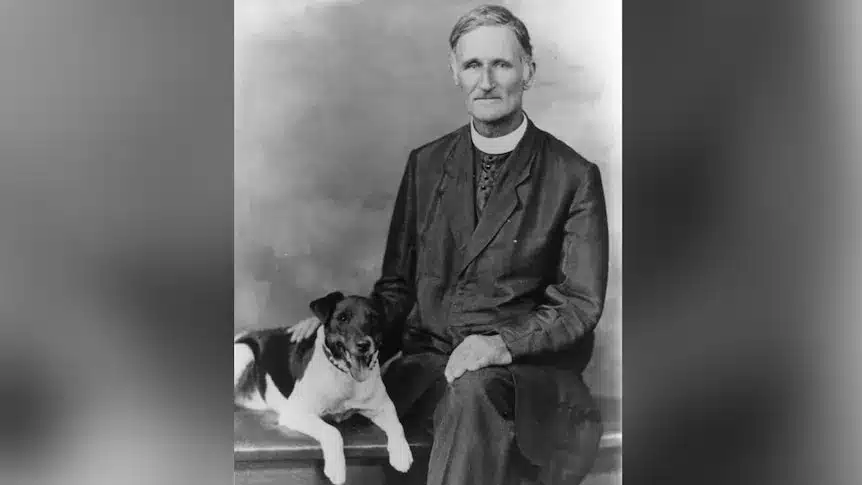
Journey Towards Sainthood for Renowned Architect-Priest
The extraordinary life of Monsignor John Cyril Hawes, a man who transitioned from a celebrated architect to a devoted Catholic priest, is undergoing rigorous examination to determine if he will be recognized as Western Australia’s first saint. Monsignor Hawes, who dedicated approximately 24 years to the region, left an indelible mark on Western Australia’s Midwest with a significant collection of sacred structures scattered across the landscape.
Originally hailing from England, Monsignor Hawes’s extensive career also saw him working in the Bahamas and traveling through America before he ultimately returned to the Bahamas to reside. Now, seven decades after his passing, a concerted effort by the Diocese of Geraldton to advance his canonization is gaining momentum. An archivist has recently undertaken international travel to interview individuals who knew the distinguished architect.
From Blueprint to Basilica: A Dual Calling
Born in Richmond, England, in 1876 to a middle-class Anglican family, Monsignor Hawes developed an early passion for architecture. This fascination, however, was later complemented by a profound conversion to Catholicism, leading him to a priestly vocation.
Throughout the Midwest, his architectural prowess is evident in iconic buildings such as Geraldton’s St. Francis Xavier Cathedral and Our Lady of Mount Carmel in Mullewa. These structures stand as testaments to his skill and dedication.
Perth Catholic Church archivist and historian, Odhran O’Brien, is currently spearheading the research into Monsignor Hawes’s life. His work aims to compile evidence for the Diocese of Geraldton’s case for sainthood. Mr. O’Brien described Monsignor Hawes’s life as “remarkable” during recent discussions.
“I think he’s a remarkable character for a number of reasons, the fact that he was such an ordinary bloke in a lot of ways but also was an Anglican who started off as an architect… then converted to Catholicism and became a priest,” Mr. O’Brien shared.
Mr. O’Brien further elaborated on Monsignor Hawes’s profound sense of mission, which was deeply intertwined with constructing sacred buildings for regional communities. “[Monsignor Hawes] had an absolute passion for architecture and he felt it was part of his mission in life,” he stated. “He was living out his faith by building these churches [and] responding to the needs of the local community to provide them with a place to gather. He built the churches from local materials in the arts and crafts style and it was about making do with the resources that you’ve got immediately around you.”
A Secret Ordination and a Long Road to Recognition
Following theological studies in Rome, Monsignor Hawes initially served as an Anglican priest. However, for nearly a decade, he grappled with his religious convictions before converting to Catholicism. He was subsequently re-ordained as a Catholic priest in a private ceremony.
“I think [Monsignor Hawes] was apprehensive about the reaction… there was a greater divide between Anglicanism and Catholicism,” Mr. O’Brien explained. “He wasn’t just an Anglican, but an Anglican priest who then converted to Catholicism, which is a pretty significant change in your life.”
Canonization Process Underway
The impetus for exploring Monsignor Hawes’s potential sainthood arose in 2017 when Archbishop Patrick Pinder of the Bahamas suggested the cause to Father Robert Cross, Chancellor of the Diocese of Geraldton. More than a decade later, Mr. O’Brien’s international research is actively gathering crucial evidence for the Diocese of Geraldton’s canonization case.
Father Cross confirmed that the archival research includes Mr. O’Brien interviewing some of the last surviving individuals who knew Monsignor Hawes personally. “[Mr. O’Brien] has actually come across one person in the Bahamas who knew Monsignor Hawes while he was still alive. And there’s evidence here in Geraldton of people turning to John Hawes in prayer, asking for divine intervention,” Father Cross stated.
He emphasized the “meticulous” and lengthy nature of the canonization process. “The very first part was to petition the congregation for the cause of saints in Rome to have his cause looked into… then he is given the title Servant of God,” Father Cross explained. “The process is very meticulous and you have to keep records of everything you do. The next stage is called the Roman stage where all the documentary evidence is gathered together and presented to the Congregation of Saints… where it is deemed [if] this is a man of extraordinary virtue.”
While acknowledging the progress, Father Cross cautioned against anticipating an immediate declaration of Western Australia’s first saint. “These things take a long time, sometimes up to 100 or more years… so I don’t expect this process will be completed anytime in the near future,” he noted. “[However] I think it would be a great privilege for the community and for Western Australia to have him declared a saint.”
