

Joe Hart Raises Concerns Over World Cup Football’s Performance
Former England goalkeeper Joe Hart has voiced suspicions regarding the flight characteristics of the official World Cup football, suggesting a potential issue after observing multiple instances of goalkeepers being beaten by similar long-range shots.
Hart, who represented England in two World Cup tournaments during his career, has theorized that keepers are finding it increasingly difficult to accurately judge the trajectory of the Adidas Trionda ball when faced with shots from distance.
Key Incidents Highlighted
His initial observations were prompted by an incident during England’s match against Croatia, where Jordan Pickford managed to get a hand to a shot from Martin Baturina but could not prevent it from entering the net. Hart also pointed to long-distance goals scored by Lionel Messi of Argentina against Algeria and Kylian Mbappe of France against Senegal, noting that goalkeepers Luca Zidane and Edouard Mendy appeared to misjudge these efforts.
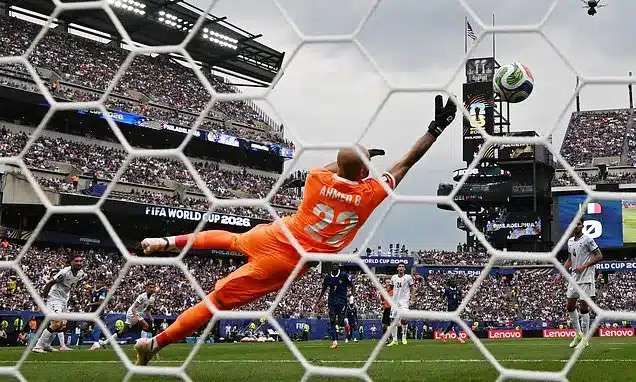
Hart reiterated his theory when Mbappe scored the opening goal for France against Iraq in a strikingly similar fashion.
Hart’s Analysis of the Ball’s Behavior
“I am seeing this goal way too many times at a World Cup for there not to be something up with that football,” Hart stated. “It is that shoulder height, as soon as they are not using a curling technique and that ball is not moving or spinning, the goalkeepers are struggling.”
He elaborated on the specific type of shot causing difficulty: “Kylian Mbappe gets it out of his feet, of course there are a few defenders in the way and that makes it difficult for [goalkeeper] Ahmed [Basil], but he has his eyes on it from this moment on. Watch the trajectory of the ball, it is not moving.”
Hart emphasized that his concern is not a criticism of the goalkeepers themselves, citing the struggles of Mendy, Zidane, and Pickford. “They just cannot seem to get their timing right with this World Cup football with anything above shoulder height that is not a curled effort,” he observed.
According to Hart, a World Cup-level goalkeeper should typically be able to react and make a save, even if it’s just to push the ball wide. “How many times at the top level do you see a goalkeeper touch it and it go in? Very rarely, because they are good enough that if they do get contact they get it wide. At this tournament, I am noticing goalkeepers getting a touch on it above shoulder height but not being able to keep it out. Something’s up.”
He believes the issue lies in the goalkeeper’s perception and reaction time. “It is the brain calculation of a goalkeeper. You see it, you get set, you get your movement in and you fly after the ball. At this tournament they are getting set and flying after it but it is just not matching up with what they are doing daily.”
Hart concluded by highlighting the fine margins at this level of competition. “There is so little margin for error at this level, but I am telling you that he will expect to save that. Lower down they are timing it sharp, but as soon as that ball has not got spin on it, it seems to be on them before they can react and they are not making the save when they do make contact.”
Context and Ball Design
While Hart has expressed his theory, no World Cup goalkeepers have publicly commented on concerns regarding the ball’s flight. This contrasts with the 2010 World Cup, where the Adidas Jabulani ball faced widespread criticism from keepers.
The Adidas Trionda, named for the concept of ‘three waves,’ features a color scheme of white, red, blue, and green, celebrating the host nations of the United States, Canada, and Mexico. Its design incorporates a blue star for the USA, a red maple leaf for Canada, and a green eagle for Mexico, drawing a parallel to the 2014 Brazuca ball.
Designers had stated that the ball’s four-panel construction, deep seams, and specially placed debossed lines were intended to provide “optimal in-flight stability.”
