

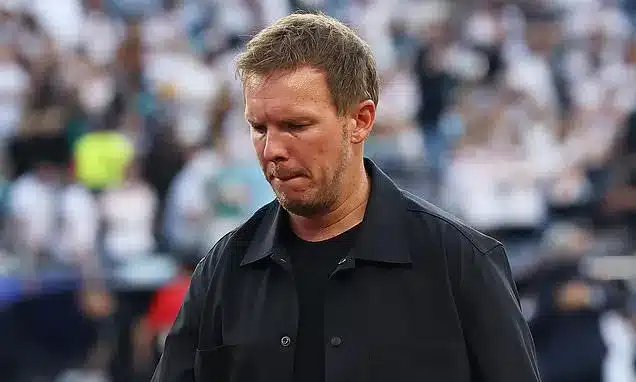
Julian Nagelsmann has declared his intention to remain as the manager of the German national football team, asserting that the German Football Association (DFB) would need to dismiss him if they seek a change in leadership. This stance comes in the wake of Germany’s unexpected and disappointing exit from the World Cup in the last-32 stage, where they were defeated by Paraguay on penalties. The result has led to significant public and media pressure, with calls for prominent figures like Jurgen Klopp to potentially take over the helm.
Germany’s World Cup Upset
The four-time World Cup champions faced a stunning defeat against Paraguay, a team considered underdogs in the tournament. This early exit from the knockout stages marks a significant low point for German football, prompting widespread disappointment and scrutiny of the team’s performance and management. The unexpected nature of the loss has intensified the debate surrounding the future direction of the national team.
Nagelsmann’s Determination to Continue
Despite the mounting pressure and speculation, the 38-year-old Nagelsmann, whose contract extends until the conclusion of the 2028 European Championships, has explicitly stated he will not step down voluntarily. He conveyed his commitment by saying, “I’m not someone who runs away. I’m available if that’s what the DFB wants.” He further elaborated on the need for clear communication from the association, stating, “If they don’t want me, they need to tell me. I want to continue.”
Nagelsmann highlighted the inherent uncertainties in professional football, noting, “In football, you don’t have complete control.” He expressed his eagerness to lead the team through upcoming tournaments, including the European Championships and the Nations League, provided the DFB shares his vision. “If the DFB wants me to, I’d be happy to prepare for the Euros and the Nations League. If they don’t want me to, they need to say it,” he added.
The Search for a New Direction
The unexpected World Cup failure has inevitably sparked discussions about potential replacements for Nagelsmann. Jurgen Klopp, a highly respected and successful manager with a proven track record in club football, has been frequently mentioned as a desirable candidate by fans and some media outlets. However, Nagelsmann’s firm resolve to stay puts the onus on the DFB to make a definitive decision regarding his future.
Context of Nagelsmann’s Appointment
Julian Nagelsmann took over the German national team with considerable expectations. His appointment was seen as a move to inject fresh energy and tactical innovation into the squad, following a period of mixed results. His previous success at club level, particularly with RB Leipzig and Bayern Munich, had positioned him as one of Europe’s most promising young managers. The current situation presents a significant challenge to his tenure, testing his resilience and the DFB’s confidence in his long-term vision.
Future Challenges for Germany
Beyond the immediate aftermath of the World Cup exit, the German national team faces crucial upcoming competitions. The qualification campaigns and eventual finals of the European Championships, along with the Nations League, represent significant opportunities to rebuild and restore confidence. Nagelsmann’s desire to lead the team through these challenges underscores his belief in his ability to turn the current situation around. The DFB’s decision will significantly shape the team’s trajectory in the coming years.
The DFB’s Decision
Ultimately, the responsibility for the national team’s managerial future rests with the German Football Association. Nagelsmann’s public declaration makes it clear that he is prepared to continue his work, but he awaits a formal decision from the association’s leadership. The DFB must weigh the performance, the manager’s commitment, public sentiment, and the potential alternatives before making a choice that will define the team’s path forward. The coming days are expected to bring further clarity on whether Nagelsmann will continue to lead Germany or if the association will opt for a change in management.
Conclusion
Julian Nagelsmann’s firm commitment to his role as Germany manager signals a period of potential uncertainty and decision-making for the DFB. While the team’s World Cup exit has fueled calls for change, including suggestions of Jurgen Klopp taking over, Nagelsmann remains resolute in his desire to continue. The German Football Association now faces the critical task of evaluating the situation and deciding whether to back Nagelsmann or pursue a new managerial direction, with upcoming tournaments like the Euros and Nations League looming.
