

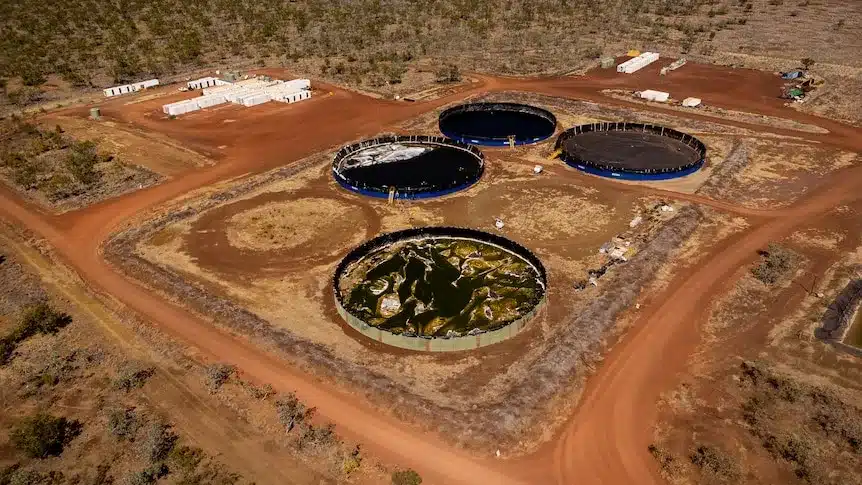
A newly unveiled climate resilience strategy by the Northern Territory government has placed the expedited development of gas extraction in the Beetaloo Basin at the forefront of its priorities. This move has ignited significant criticism from environmental organizations, who contend the plan will exacerbate greenhouse gas emissions within the Territory and worsen the impacts of climate change.
Controversial Climate Strategy Unveiled
The Northern Territory government’s climate resilience plan, released this week, designates the acceleration of gas extraction from the Beetaloo Basin as a key objective. The three-page document outlines five “strategic priorities,” including fostering a “secure and reliable energy transition,” attracting investment, and promoting emissions reduction. A central component of this strategy involves advancing the production of “low emissions energy, including from the Beetaloo Sub-basin.” Government officials assert this initiative will bolster long-term energy security for the Territory, Australia, and the broader region, while also providing reliable energy to residents at the lowest sustainable cost.
The Beetaloo Basin, situated approximately 500 kilometers southeast of Darwin, is a vast gas field estimated to be nearly half the size of Tasmania. It is believed to hold enough gas to supply Australia for an estimated 300 years.
Environmental Groups Denounce Gas-First Approach
Environmental advocates, including the Climate Council, have voiced strong opposition to the plan, arguing it will lead to an increase, not a decrease, in emissions. Ben McLeod, a senior advisor with the Climate Council, expressed dismay, stating, “You can’t have a climate resilience plan where the number one thing that the Northern Territory plans to do is drill for more gas and make climate change worse.” He further likened the approach to “putting out a house fire with diesel.”
Environment Minister Joshua Burgoyne, while unavailable for direct comment, issued a statement indicating the plan’s focus on “reducing emissions over time.” He described the Beetaloo gas supply as a “low-emissions, tightly regulated gas development” intended to support Australia’s energy transition by displacing higher-emission fuels and complementing renewable energy sources.
Debate Over “Low-Emissions Gas”
The resilience plan itself offers a rationale for classifying Beetaloo gas as “low-emissions,” citing its carbon dioxide content of one to two percent, which is presented as lower than that of alternative Australian gas sources. However, this assertion has been challenged. McLeod countered, “There’s no such thing as low-emissions gas. You can only get rid of a very small sliver of the emissions and then the rest of it you burn. You can’t avoid that.”
Michelle Isles, chief executive of the national advocacy group the Climate and Health Alliance, echoed concerns about rising emissions and their health implications. “It’s going to impact the health of Territorians. If we care about securing the future of this place, then we can’t be backing gas,” she stated. “The gas industry is trying to convince us that it is the way forward, but we know that the methane produced through gas is more potent than other emissions sources and harms human health.”
The Greens party also sharply criticized the plan. Suki Dorras-Walker, the party’s NT spokesperson, labeled it an “absolute joke,” adding, “It’s not even greenwashing, it’s openly talking about accelerating one of the biggest gas projects the Territory has ever seen. It’s not a climate resilience plan, it’s a gas expansion plan.”
Concerns for Remote Communities
Dorras-Walker also highlighted the plan’s perceived failure to address the needs of remote communities, many of which recently experienced severe flooding and required evacuation. “This has absolutely nothing in it for remote communities … some of whom [recently] experienced some of the worst flooding we’ve seen in our history, had to be evacuated from country and spend weeks in evacuation shelters.”
Unclear Emissions Targets
The Northern Territory, along with Western Australia, remains one of the few Australian jurisdictions without legislated emissions reduction targets. The Climate Council suggests the NT is lagging behind. “Even Western Australia is doing more to build renewables in the grid and making more progress there,” McLeod observed. “The Territory … is totally heading in the other direction to not only the rest of Australia, but also the rest of the world.”
When questioned about the government’s continued commitment to its 2024 election pledge of net-zero emissions by 2050, in light of the federal Liberal Party’s abandonment of its climate goals, Minister Burgoyne stated, “We acknowledge the Federal Government targets of net zero 2050.”
