

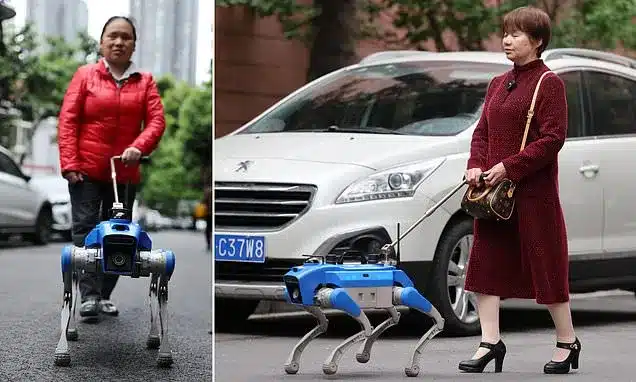
Visually impaired individuals in China are testing innovative robot guide dogs designed to enhance mobility and independence. These four-legged robotic companions respond to voice commands and use interactive systems to safely navigate urban environments.
Trials in Chengdu Demonstrate Real-World Potential
In Chengdu, Sichuan Province, a woman confidently walks down a busy street, guided by a robot dog on a leash. Equipped with cameras, antennae, and advanced sensors, the device scans surroundings to detect obstacles and plot safe paths. It adeptly manages stairs, slopes, and uneven terrain, closely mimicking the capabilities of traditional guide dogs.
China’s Push to Tackle Guide Dog Shortage
China faces a critical shortage of guide dogs, with only about 400 available for nearly 20 million blind or visually impaired people. Strict regulations often prohibit pets in workplaces and public spaces, limiting access further. Robotic alternatives aim to bridge this gap.
In 2024, developers unveiled a six-legged robot dog, roughly the size of an English Bulldog. Its integrated cameras and sensors enable navigation for visually impaired users, including recognition of traffic signals.
Chinese couple Li Fei and Zhu Sibin participated in early testing. Li Fei shared, “If this robot guide dog comes onto the market and I could use it, at least it could solve some of my problems in travelling alone. For example, if I want to go to work, the hospital or the supermarket—I cannot go out alone and must be accompanied by my family or volunteers.”
Global Innovations in Assistive Robotics
Similar technology emerges elsewhere. Two years ago, the University of Glasgow introduced Robbie the RoboGuide, leveraging sensors and AI to describe environments to users.
Principal investigator Dr. Olaoluwa Popoola emphasized, “The model was not intended to replace guide dogs but supplement them and relieve shortages.” He added, “Assistive technologies like the RoboGuide have the potential to provide blind and partially sighted people with more independence in their daily lives in the years to come.”
Dr. Popoola highlighted limitations in existing robots: “One significant drawback of many current four-legged, two-legged and wheeled robots is that the technology which allows them to find their way around can limit their usefulness as assistants for the visually impaired. Robots which use GPS to navigate, for example, can perform well outdoors, but often struggle in indoor settings, where signal coverage can weaken. Others, which use cameras to ‘see’, are limited by line of sight, which makes it harder for them to safely guide people around objects or around bends.”
