

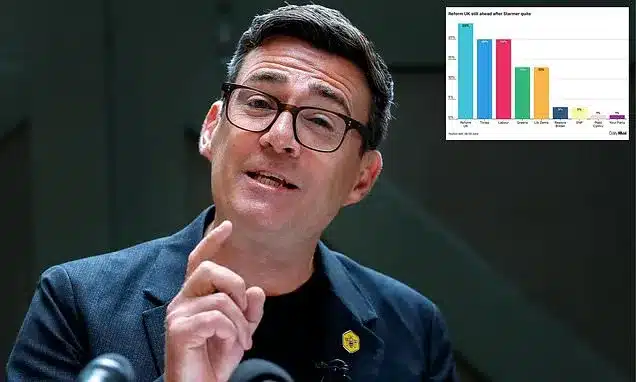
Labour’s support has seen a marginal increase in the latest polling following the announcement of Keir Starmer’s resignation and growing speculation around Andy Burnham potentially succeeding him. A recent survey by YouGov indicates a two-percentage-point rise in Labour’s backing, bringing their total to 20 percent. However, this uptick falls within the margin of error from the previous poll, and the party continues to trail Reform UK by a significant four points.
Labour’s Shifting Support Landscape
The latest YouGov poll places Reform UK at 24 percent, a one-point decrease from the prior survey. The Conservative Party remains unchanged at 20 percent. Meanwhile, the Green Party has seen a two-point drop to 13 percent, and the Liberal Democrats are down one point, also at 13 percent. This figure represents the lowest recorded support for the Green Party since October and is an eight-point decline from their peak in early March, which coincided with their victory in the Gorton and Denton by-election.
Encouragingly for the UK’s traditional political landscape, the combined vote share for Labour and the Conservatives has reached 40 percent. This is the highest aggregate support for the two major parties since July of the previous year, suggesting a potential consolidation of the vote around the established parties amidst the current political flux.
Andy Burnham’s Leadership Prospects and Policy Vision
Keir Starmer announced his intention to step down as Labour leader on Monday, following Andy Burnham’s victory in the Makerfield by-election. With no other declared contenders for the leadership, Burnham, the former Mayor of Greater Manchester, is widely anticipated to become the next Labour leader and potentially Prime Minister. He is slated to assume leadership on July 20th, provided he remains the sole candidate.
In his first significant address since Starmer’s resignation, Burnham outlined a compelling vision for a “rewired Britain,” centered on decentralization and regional empowerment. He proposed establishing a new Number 10 operation based in Manchester, intended to serve as the “nerve centre” for this transformative agenda. This move signals a strong commitment to shifting political and administrative power away from traditional Whitehall structures.
Key Policy Proposals from Andy Burnham
- Housing Initiative: Burnham pledged to initiate the largest council house building program since the post-war era, addressing critical housing shortages.
- Public Service Control: He intends to grant regions greater public control over essential services, including water, energy, and transport, fostering local autonomy.
- Devolution of Power: A core tenet of his platform is the “biggest rebalancing of power our country has seen,” aimed at overcoming resistance from central government to devolving authority to the regions and nations.
Burnham explicitly stated, “The days of Whitehall fighting the devolution of power into the regions and nations are over for good.” This assertive stance underscores his commitment to a fundamental restructuring of governance in the UK.
Economic Reassurance and Fiscal Prudence
Addressing potential concerns from financial markets regarding his ambitious plans, Burnham sought to reassure voters and investors about his approach to public spending. He emphasized that his proposals would be underpinned by “the stability that comes from sound public finances” and adherence to “the discipline of our current fiscal rules.” This suggests a commitment to fiscal responsibility, aiming to avoid a significant increase in borrowing and taxes.
However, he also acknowledged the ongoing economic challenges faced by households, particularly concerning the cost of living. Burnham indicated that taxpayer-funded support would likely be necessary to alleviate these pressures, demonstrating an awareness of the immediate needs of the populace while balancing them with long-term fiscal strategy.
Polling Methodology
The YouGov survey was conducted among 2,437 British adults between June 28th and June 29th, providing a snapshot of public opinion during a period of significant political transition for the Labour Party.
Conclusion
While Labour has seen a slight uptick in its polling numbers following Keir Starmer’s resignation, the gains are modest and within the margin of error. The focus now shifts to Andy Burnham, who is poised to take the party’s leadership. His ambitious vision for a decentralized Britain, coupled with promises of significant social and infrastructure investment, will be closely watched by the public and financial markets alike. Burnham’s challenge will be to translate his policy proposals into tangible political momentum and to reassure the electorate and the markets of his party’s economic stability.
