

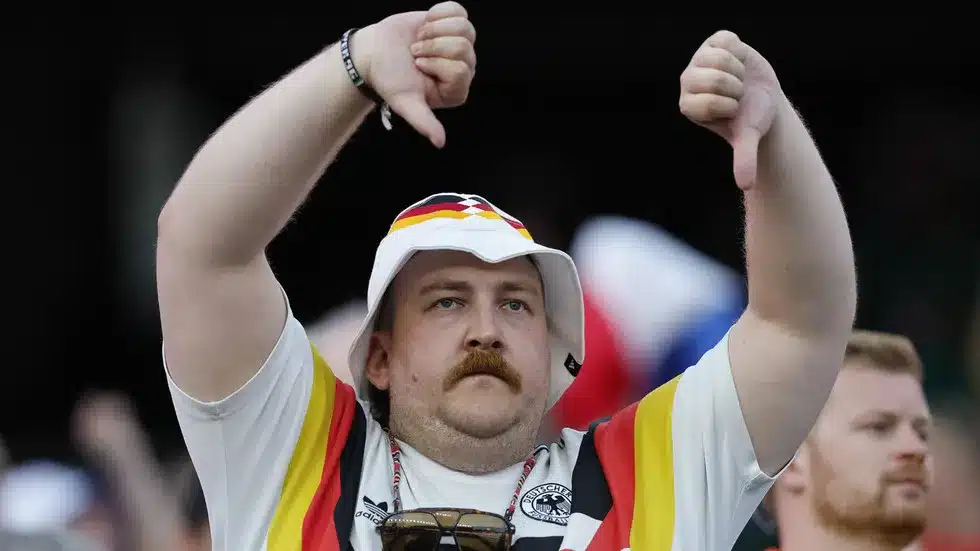
Germany’s unexpected elimination from the World Cup in a penalty shootout against Paraguay has sparked widespread discussion, with many viewing the football team’s performance as a metaphor for the nation’s current standing in economic and social spheres. The defeat, which occurred in the first knockout stage of the tournament, has been described by some as a “football nightmare” and a “night of shame,” particularly given Germany’s historical success in international football, including four World Cup titles and three European Championships. The team, ranked 10th globally, was favored against 41st-ranked Paraguay, making the outcome a significant upset.
A Shift in Football Fortunes
This World Cup exit marks a continuation of a challenging trend for the German national team. Following their 2014 World Cup victory, Germany failed to advance from the group stages in both the 2018 and 2022 tournaments. Manager Julian Nagelsmann acknowledged this decline, stating, “this is the third elimination in a row, so we are not part of the first-class teams any more.” The sentiment was echoed by tabloid newspaper Bild, which labeled the loss a “night of shame.”
Chancellor Merz’s Response and Public Reaction
In the wake of the defeat, Chancellor Friedrich Merz attempted to offer words of encouragement to the team, posting on social media platform X: “With your commitment and team spirit at this World Cup, you have thrilled our country.” He further added, “We celebrate our successes together. And in defeat, we stand united. That is what makes us strong. Whoever wears the eagle on their chest has earned our support and not our scorn.”
However, this message did not resonate with many citizens. Critics, including author and entrepreneur Mario Lochner, expressed dismay, with Lochner replying, “This tweet stands for everything that’s wrong in this country. And then people wonder why you’re the most unpopular politician on the planet.” Satirist Johannes Normann quipped that the current “New Germany” is “nothing more than third-rate,” even in football. Right-wing author Oliver Gorus described the elimination as “a rock-bottom kick,” suggesting the team was “miserably led” and that the outcome was “a mirror image of the whole country.”
Political Interpretations of the Football Defeat
The performance of the national team was also seized upon by political figures. Tino Chrupalla, co-chairman of the right-wing Alternative for Germany (AfD) party, drew a parallel between the team’s performance and the current government’s actions. He posted, “It seems that Merz is applying the same yardstick to the national team as he does to his governing coalition.” Chrupalla emphasized the need for a return to a “principle of performance” for politicians and athletes alike, stating, “Germany must get back to the top!” AfD leader Alice Weidel characterized the nation’s situation as moving “from one embarrassment to the next.”
Broader National Challenges
The football team’s struggles are seen by some as symptomatic of wider issues facing Germany over the past decade. Since their 2014 World Cup triumph, the country has grappled with significant economic and social shifts. These include challenges related to immigration policies implemented around 2015, which some argue have impacted social cohesion. Economically, Germany has faced hurdles including the phasing out of nuclear power in favor of renewables, and the disruption of energy supplies following the escalation of the Russia-Ukraine conflict in 2022, which led to soaring energy costs and economic contraction.
Major German manufacturers such as BASF, Bosch, and Volkswagen have announced plant closures and significant job losses in recent years. Volkswagen, a key indicator of the nation’s economic health, has shut down multiple factories. Furthermore, Germany’s international standing has faced scrutiny, highlighted by its failure to secure a seat on the UN Security Council for the first time since 1977. This diplomatic setback was attributed by some to perceived inconsistencies in its foreign policy.
Economic Headwinds and Industrial Shifts
The German economy, once a powerhouse, has experienced a period of stagnation. Following two years of contraction, growth has remained sluggish, below 1%. This economic climate has prompted major industrial players to reassess their operations within Germany. The closure of plants by prominent companies like Volkswagen, Bosch, and BASF underscores the difficulties facing the manufacturing sector, exacerbated by high energy prices and global economic uncertainties.
Energy Policy and Geopolitical Factors
Decisions regarding energy policy, including the transition away from nuclear power and the subsequent reduction in reliance on Russian gas, have had profound effects. The Nord Stream pipeline incidents, occurring while Germany’s leadership remained largely silent, have also been cited as contributing factors to the nation’s energy security concerns and economic vulnerability. Chancellor Merz’s commitment to strengthening the military, building “the strongest conventional army in Europe,” has also drawn attention, particularly regarding its impact on the national budget, with significant defense spending contributing to a budget deficit exceeding EU limits.
The Role of Sporting Success in National Morale
While a World Cup victory would not have resolved these complex issues, proponents argue that sporting success can provide a much-needed boost to national morale. Historical examples, such as Cameroon’s performance in the 1990 World Cup, South Korea’s achievements in 2002, and Ireland’s run in 1990, illustrate how sporting triumphs can unite a nation and offer a sense of collective pride and celebration, particularly during times of economic hardship. For Germany, with Chancellor Merz’s approval ratings reportedly low, a World Cup win could have offered a rare moment of public jubilation. Instead, the team’s early exit has, for some, reinforced a narrative of national decline.
Conclusion
The German national football team’s World Cup defeat to Paraguay serves as a focal point for broader discussions about Germany’s current position on the global stage. The disappointment on the pitch is, for many observers, intertwined with ongoing economic challenges, shifts in industrial output, energy policy debates, and geopolitical considerations. While sporting victories can offer temporary respite and boost national spirit, the underlying issues facing Germany require sustained attention and strategic solutions beyond the realm of international football.
