

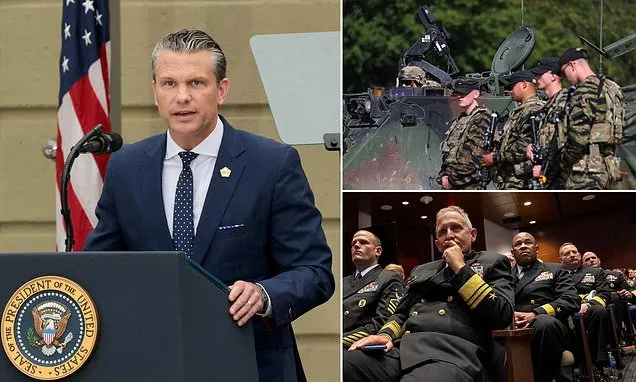
The Pentagon has issued a directive requesting that commanders nominate only the fittest service members, those with “impeccable grooming,” to attend an upcoming State of the Force address by Defense Secretary Pete Hegseth. This requirement emphasizes a high standard of physical readiness and professional presentation for attendees of the event scheduled for later this month.
Strict Selection Criteria for Hegseth Address
Pentagon officials communicated in an email obtained by The Wall Street Journal that prospective attendees must meet specific “physical standards.” These criteria include successfully passing the Army’s waist-to-height ratio assessment and the Army fitness test. Furthermore, the directive explicitly states the need for “impeccable grooming (no exception).”
Beyond physical and appearance requirements, candidates are expected to demonstrate exceptional performance within their units. The selection process will favor individuals who are “consistently rated as top performers,” possess a “clear record of integrity, discipline and selfless service,” and can “demonstrate strong presence, clear communication and sound judgment under pressure.” The aim is to select service members who “serve as role models for their peers and subordinates.” The final selection will be based on “demonstrated leadership quality and professional character,” with attendees also having the opportunity to engage in a workout session with Secretary Hegseth.
Similar messages were reportedly sent to other commands throughout the military, indicating a broad application of these selection standards.
Hegseth’s Previous Remarks on Military Standards
This directive follows a similar event held a year prior at Marine Corps Base Quantico. During that address, Secretary Hegseth reportedly called for an end to what he termed “beardo” and “fat generals,” advocating for a vision of troops and commanding officers unburdened by what he described as “woke politics, DEI and ‘dudes in dresses.'” His remarks at that time were noted for their blunt language.
At that previous gathering, Hegseth articulated his view that a male standard of fitness should apply to all troops, expressing his dissatisfaction with seeing service members in poor physical condition. He clarified that these new rules were not intended to exclude women but rather to establish gender-neutral physical standards. “If women can make it, excellent, if they cannot — then so be it,” he stated, adding that such standards would also exclude “weak men.” He emphasized the importance of rigorous training, suggesting a return to “scary, tough, disciplined” protocols where drill sergeants could have more direct physical interaction with recruits.
Hegseth’s previous address drew varied reactions from military officials. Some expressed surprise at the direction and tone of his speech, particularly concerning his views on cultural issues within the military. Concerns were raised about the politicization of the military and the appropriateness of a speaker with a background as a former junior soldier and television host lecturing senior officers on military standards.
Health and Readiness Initiatives
In addition to the focus on physical appearance and performance for the upcoming event, Secretary Hegseth has championed other health and readiness initiatives. In July, he announced a policy introducing mandatory annual testosterone screenings for active-duty U.S. service members aged 30 and older. This measure was framed as a strategy to maintain troops at the “leading edge of lethality.”
This policy, which Hegseth referred to as a “modern step” to optimize the biological readiness and long-term health of combat forces, was introduced via a video on his official social media account. A source close to Hegseth indicated that the initiative was a response to “operator syndrome,” a condition characterized by a complex set of physiological and psychological health issues, including endocrine disruption, chronic joint pain, traumatic brain injury, and depression. This syndrome is often observed in special operations forces and long-serving combat veterans who have endured prolonged deployments and chronic stress.
Under this health initiative, testosterone level assessments are being integrated into the military’s standard annual health evaluations. While mandatory for service members over 30, those younger than 30 have the option to undergo the screening voluntarily.
Conclusion
The directive for the State of the Force address underscores a continued emphasis on stringent physical standards and professional conduct within the U.S. military, reflecting Secretary Hegseth’s broader agenda for enhancing troop readiness and lethality.
