

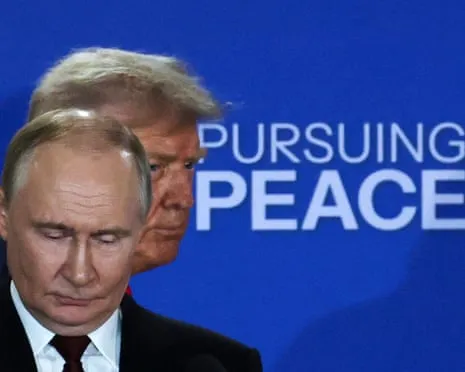
Shifting objectives, vague timelines, and questionable pretexts define the US-Israel campaign against Iran, revealing striking parallels to Russia’s invasion of Ukraine.
The scenarios differ significantly: Russia launched a full-scale ground assault on Ukraine in 2022, a democratic nation, leading to substantial casualties. In contrast, the US focuses primarily on airstrikes targeting Iran’s authoritarian regime. Nevertheless, key similarities emerge in strategy and rhetoric.
Evolving Objectives
Early statements positioned US strikes as measures to block Iran’s nuclear ambitions, dismantle missile systems, and undermine support for regional proxies. Objectives have since escalated. President Trump demands replacement of Iran’s leadership and Tehran’s unconditional surrender, hinting at regime change.
Russia followed a similar pattern in Ukraine. Putin initially cited “demilitarization and denazification”—terms viewed as code for ousting Kyiv’s government. As fighting persisted, goals shifted to safeguarding Russian speakers in the east and annexing seized territories.
Defensive Rhetoric
Both campaigns frame actions as responses to imminent threats, despite expert skepticism. Defense Secretary Pete Hegseth declared the US “didn’t start this war, but under President Trump, we are finishing it.”
Putin used nearly identical phrasing: “We didn’t start the so-called war in Ukraine. We are trying to finish it.”
Expectations of Swift Victories
Leaders on both sides anticipated quick resolutions. Putin envisioned a weeks-long operation akin to the 2014 Crimea annexation. Trump gained momentum from the recent US capture of Venezuela’s President Nicolás Maduro.
Reluctance to label actions as “war” underscores brief-conflict hopes. Russia terms its Ukraine effort a “special military operation,” backed by censorship jailing dissenters. In the US, House Speaker Mike Johnson described it as a “limited operation.” The New Yorker satirized this with a mocked-up War and Peace cover reading “Limited Combat Operation.”
Shifting Elite Reactions
Russian establishment figures, initially shocked by the Ukraine invasion, rallied to demand completion of the mission. US commentators, once vocal critics of Russia, now echo similar support. Former US Ambassador to Moscow Michael McFaul posted on X: “Once our presidents make a decision to go to war, even when I disagree with the decision and process—as is the case with our current war with Iran—I still want our armed forces to win.”
Emerging Risks
Media reports indicate Trump eyes deploying elite troops to secure Iran’s enriched uranium stockpiles, mirroring Russia’s early, failed airborne assault on a Kyiv airport.
Atlantic Council fellow Danny Citrinowicz warns that overly ambitious aims risk a grinding war of attrition. “To avoid that outcome, it is essential to define clear, realistic objectives—ones that can be measured and that provide a clear point at which the campaign can end,” he posted on X.
Retired Russian diplomat Vladimir Frolov quipped: “Sounds familiar.”
